Every card, marked to market.
Stop refreshing five tabs to know what your binder is worth. Vault pulls realized comps every few minutes and rolls them into a portfolio view you can export anytime.
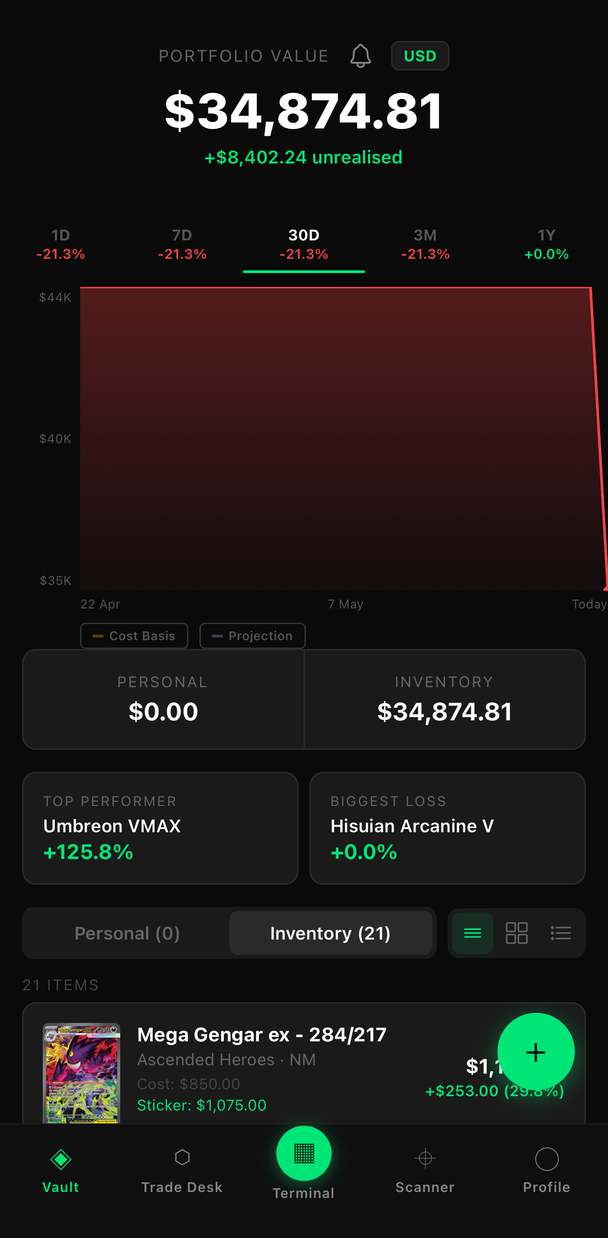
A portfolio view, built for cardboard.
The same primitives a fund manager would expect — live valuations, cost basis, P&L, exports — applied to the asset class you actually care about.
-
Live valuationsPulled from realized comps every 5 minutes during US market hours.
-
Sealed productETBs, booster boxes, cases, premium collections — priced by SKU and rarity.
-
Graded slabsPSA / BGS / CGC tracked by grade. Pop reports update with each market sync.
-
Cost basisTag what you paid. Vault rolls up unrealized P&L by line, by set, by month.
-
Inventory exportExport a PDF or CSV of your full collection with values, grades, and serials.
01What gets tracked
Vault is built around three asset types — and you tag a card once, when you add it. After that, Vault handles classification, valuation, and reporting on its own.
- Singles. Raw, sleeved, top-loadered. Identified by set, number, language, and condition.
- Sealed product. ETBs, booster boxes, cases, premium collections, special sets. Priced by SKU and condition (factory / opened / damaged).
- Graded slabs. PSA, BGS, CGC — by grade. Serial number stored when present; pop reports refresh with each market sync.
02How valuations work
Every line in Vault is priced from realized comps — actual sales prices from the trailing 30 days, not asking prices or list prices. The pricing engine is the same one that powers the Terminal's Deal Grader.
During US market hours, valuations refresh every 5 minutes. Off-hours, valuations are stamped to the last in-hours close. If a card has too little volume to support a fair market value, Vault marks it as illiquid and shows the last realized price with a confidence flag — never a guess.
03Cost basis and P&L
Tag the price you paid when you add a card to Vault. From that moment, Vault tracks unrealized profit-and-loss against the live valuation, with rollups available by line, by set, and by month. There's no tax treatment — Vault tells you the spread between what you paid and what the market is currently doing, nothing more.
For collectors who track cost basis across multiple wallets or accounts, Vault supports labeling lines by source ("show pickup", "online", "trade-in") so the same card type can carry different basis depending on where it came from.
04Export formats
Vault exports the same data two ways — pick whichever format matches what you need it for.
- PDF. A printable inventory ledger with cover page, totals, and a line-by-line list including grade, quantity, and serial. Useful for personal records or anything you need to hand to someone.
- CSV. One row per holding, with all the underlying fields (set, number, grade, serial, cost basis, current value, P&L). Useful for spreadsheets, accounting software, or anywhere you want to do further analysis.
Exports always reflect the live Vault state at the moment you generate them. There's no automatic emailing or scheduled-export feature — that's deliberate. The Vault is the source of truth; an export is a snapshot.
Realized comps, spread, sentiment, pop, and forecast — fused into a single Prism grade per deal.
Explore Terminal →In-person trades, settled on a two-sided ledger. Both phones tap, both sides sign, the receipt writes to both Vaults.
Explore Trade Desk →Vault your collection from day one.
Founding-member pricing locks at the pre-launch rate. iOS and Android, Q3 2026.
Download onthe App StoreGet it on
Google Play